
Part 1: The Problem We’re In
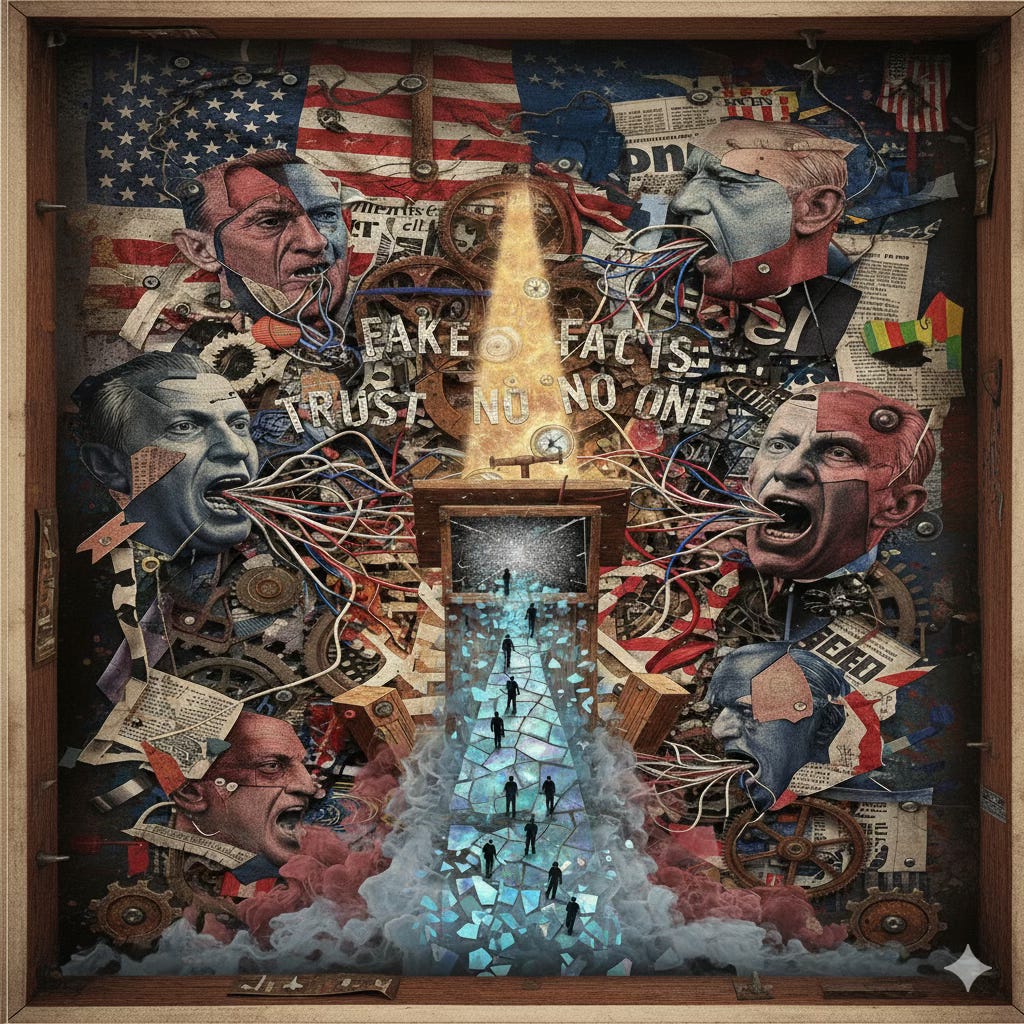
American politics has become incomprehensible. Half the country is unintelligible to you. You look at what the other side believes and can’t understand how intelligent people arrive at those conclusions. You try to engage across difference and end up frustrated, speaking different languages. You wonder if they’ve lost their minds, or if maybe you’re the one missing something. This isn’t just disagreement—American politics has become incoherent.
You’re tired of being told one side is entirely right and the other evil or stupid. You’re suspicious of that framing, but also suspicious of the “both sides” cop-out that treats all positions as equally valid. You want to think independently, but every source of information seems to come with tribal allegiance built in.
When you try to understand perspectives different from your own, you worry about being manipulated — about taking on their biases without realizing it. But when you reject those perspectives out of hand, you feel like you’re contributing to the problem. You’re caught between dismissing half the country and losing your ability to think clearly about what’s actually true and right.
Meanwhile, the stakes feel impossibly high. Democracy itself seems fragile. Basic facts are contested. Violence lurks at the edges. Institutions that once seemed stable now feel vulnerable.
What This Series Offers
This series won’t tell you what to believe about specific issues. Instead, it offers a framework for finding coherence through better engagement with disagreement — a way to assess conflicts, understand different perspectives, and respond appropriately without either dismissing them automatically or abandoning your own capacity for independent thought.
The core insight: not all political conflicts are the same type, and treating them all the same way — whether that’s militant opposition or open-minded engagement — leads to poor judgment. What you need is discernment: the ability to recognize what kind of situation you’re facing and respond appropriately.
But here’s what makes this harder: when you try to engage opposing views thoughtfully, your most difficult conversations are often with people who share your politics. They see your attempt to understand the other side as betrayal. Finding coherence means learning to navigate disagreement in all directions across partisan lines AND within your own tribe.
This series introduces the framework. Future posts will dive deeper into applications and complications—how to judge political character, navigate expertise when consensus is contested, extend grace across difference, distinguish valid skepticism from pure conspiracism, and yes, how to engage with your own side when you’re trying to understand opposing views. But first, we need to build the diagnostic tools themselves.
The Structure Ahead
Part 2 makes the strongest possible case for viewing conflict as productive — arguing that many of our deepest disagreements reflect permanent tensions between competing goods, not simple conflicts between right and wrong.
Part 3 challenges this view by examining situations where productive contestation isn’t enough — where power asymmetries, factual questions, and moral violations require different approaches.
Part 4 develops a framework for distinguishing types of conflicts and responding appropriately to each, giving you tools for better political judgment.
Part 5 grounds this framework in American constitutional principles, explaining why the founding documents — despite their flaws — provide the shared foundation we need.
What’s at Stake
American democracy is under real strain. Not just that people disagree — we’ve always disagreed — but that we’ve lost the ability to engage disagreement productively. More people question whether elections are legitimate. More people see political opponents not as fellow citizens with different views but as existential threats. And increasingly, people who try to engage across difference face punishment from their own side.
At the same time, real problems demand attention: economic inequality, climate change, technological disruption, immigration reshaping communities, cultural change creating both opportunity and dislocation. These aren’t fake problems. They’re genuine challenges requiring responses. But we can’t address them if we can’t engage disagreement about how to respond.
This isn’t abstract. It affects whether you can have productive conversations with family members who voted differently. Whether you can work alongside colleagues with different political views. Whether you can participate in community life without it becoming consumed by partisan conflict. Whether democratic self-governance remains possible when tribal enforcement makes thoughtful engagement feel dangerous.
The Promise
Here’s what I’m offering: not certainty, but better judgment. Not a way to eliminate disagreement, but a path toward finding coherence by learning to engage disagreement better. Not a formula that provides answers to every question, but tools that help you navigate what kind of disagreement you’re facing.
By the end of this series, you’ll have a framework for distinguishing different types of political conflicts that require fundamentally different responses. You’ll recognize when your opponents see something real you might be missing. You’ll know when to engage across difference and when engagement is counterproductive. You’ll maintain both strong convictions and epistemic humility.
Most importantly, you’ll have reasons for hope — not naive optimism that ignores real threats, but grounded confidence that we can find our way through this if we develop better judgment about how to engage our deep disagreements.
Understanding different types of disagreement is just the beginning. Future posts will explore an equally hard challenge: how to engage with your own side about opposing views in healthy ways. Because when you try to understand the other side, you often face your hardest conversations with people who share your politics. Finding coherence means learning to navigate both.
The path forward starts here: recognizing that not all conflicts are the same, and that engaging them wisely requires discernment.
Stay tuned for Part 2…